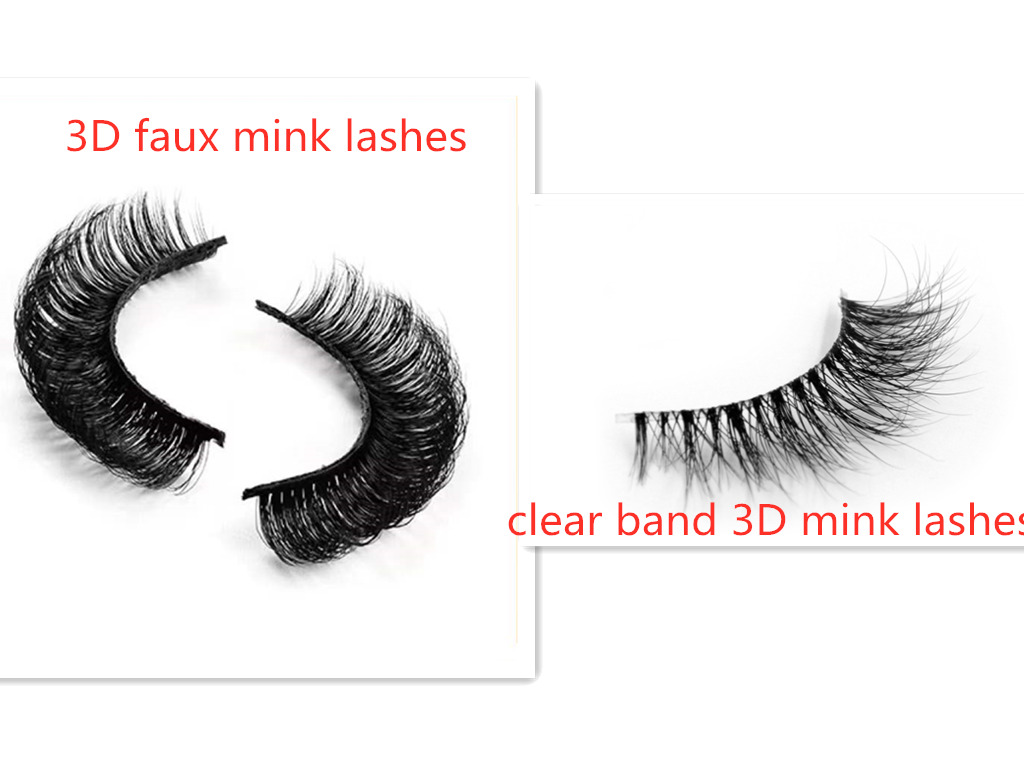
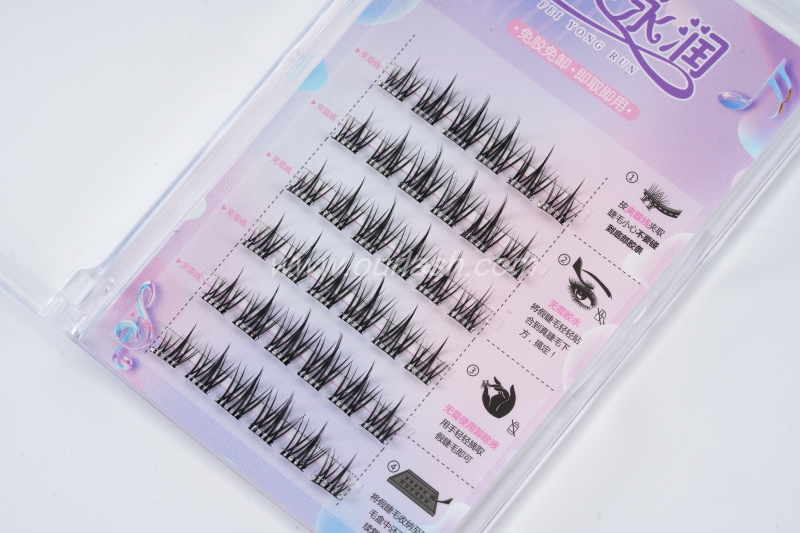
Self-adhesive false eyelashes (some one call pre glued eyelash ) have become a staple in many people’s makeup routines, thanks to their convenience—no extra glue tube needed, no messy application, and quick wearability. However, anyone who has used them regularly knows that not all self-adhesive false eyelashes live up to their promises. Some fall off within hours, feel uncomfortable on the eyelids, or even damage natural lashes. The frustration of a poorly functioning pair often leaves users wondering: why do some self-adhesive false eyelashes fail to work well? The answer lies primarily in two key factors: the quality and application of the adhesive, and the overall craftsmanship of the false lashes themselves. Among these, the adhesive is the most critical determinant of performance.
The adhesive used in self-adhesive false eyelashes is the backbone of their functionality, and its quality varies dramatically based on origin, application method, and precision—all of which directly impact how well the lashes stay in place. One of the most obvious differences is the origin of the glue: most self-adhesive lashes use either Chinese-made or Korean-made adhesive. Korean-made glue is widely recognized as superior in performance. It typically has a stronger, longer-lasting bond that can withstand daily activities like talking, laughing, or even light sweating without peeling off. Additionally, Korean glue is often formulated to be gentler on the skin, reducing the risk of irritation around the sensitive eye area, which is crucial since eyelid skin is some of the thinnest on the body. However, this quality comes at a cost—Korean adhesive is significantly more expensive than its Chinese counterpart, which leads many budget-friendly brands to opt for Chinese-made glue to cut costs. Chinese-made glue is more affordable, but it often has weaker adhesion, dries faster but becomes brittle, and may contain harsher ingredients that can cause redness or itching for sensitive users. In some cases, low-quality Chinese glue even contains harmful substances like formaldehyde, which poses long-term risks to eye health. Besides origin, the viscosity of the glue is another key factor that is easily ignored. The glue should neither be too sticky nor not sticky enough, but just the right viscosity. If the glue is too sticky, it will be extremely difficult to adjust the position of the false lashes during application, and it may even pull or damage the natural lashes when removed. On the contrary, if the glue is not sticky enough, it will fail to form a firm bond with the eyelid, causing the false lashes to fall off easily within a short time. Only glue with moderate viscosity can balance the convenience of application and the firmness of adhesion, ensuring that the false lashes stay in place steadily while being easy to adjust and remove without harming natural lashes.
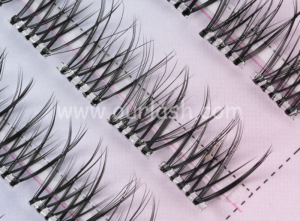
Beyond the origin of the glue, the method of application—machine vs. manual gluing—also plays a vital role in the performance of self-adhesive false eyelashes. Machine gluing is the more common method used by mass-market brands due to its efficiency and low cost. However, machines lack the precision of human hands, leading to two common problems: uneven glue distribution and insufficient glue quantity. Uneven gluing means some parts of the lash band have too much glue (which can seep out and irritate the eyes or create a messy appearance) while other parts have too little (resulting in weak adhesion and easy peeling). Insufficient glue, in particular, is a major issue—even high-quality glue will fail to hold if there is not enough of it applied to the lash band. On the other hand, manual gluing offers far more stability and precision. Skilled workers can evenly distribute the right amount of glue along the entire lash band, ensuring consistent adhesion from the inner to the outer corner of the eye. Manual gluing also allows for adjustments based on the lash band’s shape, ensuring the glue covers every critical area. The downside is that manual labor is costly, which increases the price of the final product—making manually glued lashes a luxury option that many budget-conscious consumers cannot afford.
A third issue related to glue is incorrect application position, which is often overlooked but can render even high-quality glue ineffective. The glue should be applied along the entire length of the lash band, close to the base (but not too close to the edge, as this can cause the glue to touch the skin directly). However, some manufacturers apply glue only to the middle of the lash band, leaving the inner and outer corners unglued or under-glued. These corners are the most prone to lifting because they experience the most movement during facial expressions. When the inner or outer corner peels off, the entire lash can shift or fall off, ruining the makeup look and causing frustration. Incorrect gluing position can also lead to discomfort—if glue is applied too close to the edge of the lash band, it may come into contact with the eyelid or even the eye itself, causing irritation or a burning sensation.
While glue is the most critical factor, the overall quality of the false lashes themselves is another key reason why some self-adhesive pairs perform poorly. Poorly crafted lashes often suffer from three main issues: shedding, fragile lash bands, or overly stiff lash bands. Lash shedding occurs when the individual lash fibers are not securely attached to the band. This is often due to low-quality materials—such as cheap synthetic fibers that lack durability—or shoddy manufacturing processes. When the lashes shed, they leave gaps in the lash band, ruining the full, voluminous look users desire and making the lashes appear unkempt. Some low-quality lashes even shed during application, leaving tiny fibers on the eyelid or in the eye, which can cause irritation.
The lash band, which serves as the foundation for the entire lash, is another point of failure in poorly made self-adhesive false eyelashes. A high-quality lash band should be flexible yet sturdy—able to bend and conform to the natural curve of the eyelid without breaking or losing its shape. However, some bands are too fragile, easily tearing when handled or when applying pressure to secure the lashes. A fragile band can also break mid-wear, causing the lashes to fall off completely. On the opposite end of the spectrum, some lash bands are overly stiff, made from thick, rigid materials that cannot conform to the eyelid’s curve. These stiff bands feel uncomfortable on the eye, pressing into the eyelid and causing irritation or soreness after just a few hours of wear. They also fail to adhere properly because they cannot lie flat against the skin, creating gaps between the band and the eyelid where the glue cannot form a strong bond. High-quality lash bands, by contrast, are often made from soft materials like silk, suede, or thin cotton, which are flexible, lightweight, and gentle on the skin.
In conclusion, the performance of self-adhesive false eyelashes depends largely on two interconnected factors: the quality and application of the adhesive, and the craftsmanship of the lashes themselves. The adhesive, as the most critical component, is affected by its origin (Korean-made glue is superior but more expensive), application method (manual gluing is more reliable than machine gluing but costlier), and application position (incorrect gluing leads to poor adhesion and discomfort). The false lashes themselves can fail due to shedding, fragile bands, or overly stiff bands—all of which stem from low-quality materials and shoddy manufacturing. For consumers, understanding these factors can help in making more informed choices when purchasing self-adhesive false eyelashes, avoiding the frustration of poorly functioning products and ensuring a comfortable, long-lasting wear that enhances their makeup look without compromising eye health.+
This is OURLASH, if you have other questions about eyelash, contact with us.