
This is OURLASH, as a eyelash manufacturer, we do not talk about eyelash. Today, we talk about three main types of cosmetic double eyelid surgery.
Double eyelid surgery, also known as blepharoplasty, is one of the most popular and mature cosmetic procedures worldwide. Its core goal is to create a natural upper eyelid crease, brighten the eye shape, visually enlarge the eyes, and enhance the three-dimensionality of facial features. With the continuous advancement of medical aesthetic technology, three mainstream and standardized techniques have been formed: buried suture method, three-point minimally invasive method, and full-incision method. Each has unique operating principles, suitable crowds, advantages, and limitations. Choosing the right technique based on one’s eye condition is key to achieving natural, long-lasting, and safe results.
The first and least invasive technique is the buried suture method, also called non-incision double eyelid surgery. This procedure requires no surgical cutting on the eyelid skin. Surgeons use fine medical sutures to penetrate the upper eyelid through tiny needle holes, embedding the sutures under the skin to form artificial adhesion between the upper eyelid skin and the tarsal plate. This stable connection creates a natural double eyelid crease. As a non-invasive method, it has obvious advantages: minimal trauma, almost no swelling or bruising after surgery, ultra-fast recovery, and no visible scars. Most patients can return to daily life within 3 to 5 days.
However, the buried suture method has strict applicable conditions. It is only suitable for young people with thin upper eyelids, little orbital fat, tight skin, no sagging tissue, and no puffy eye bags. For those with thick, puffy eyelids or loose aging skin, this method cannot remove excess fat or skin, leading to unnatural creases or even failure. Additionally, the adhesion from buried sutures is relatively weak. Over time, repeated facial muscle movement may loosen the sutures, causing the crease to fade or disappear, so its durability is limited compared to incision-based methods.
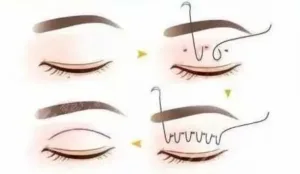
The second mainstream technique is the three-point minimally invasive double eyelid surgery, also known as partial-incision surgery. It combines the advantages of the buried suture and full-incision methods, balancing naturalness, durability, and recovery speed. During the operation, the surgeon makes three tiny, symmetrical incisions (2 to 3 millimeters each) at fixed positions on the upper eyelid. Through these small openings, excess orbital fat can be removed to improve puffy eyelids, and the skin and tarsal plate are stitched to form a delicate crease.
Compared with the buried suture method, the three-point minimally invasive method forms firmer tissue adhesion, making the crease more stable and long-lasting. It can slightly improve mild fat swelling and skin relaxation that the non-incision method cannot solve. Meanwhile, its trauma is much smaller than the full-incision surgery, with moderate postoperative swelling and a recovery cycle of about 1 to 2 weeks, leaving almost no obvious scars. This method is suitable for most young people with slightly fat eyelids, mild eye swelling, and basically tight skin. Its only disadvantage is that it cannot address severe upper eyelid sagging or excessive fat accumulation.
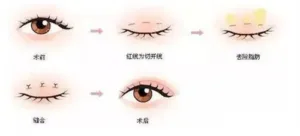
The third classic and most comprehensive technique is thefull-incision double eyelid surgery. As the most traditional and versatile method, it requires the surgeon to make a complete continuous incision along the natural radian of the upper eyelid crease. Through the incision, doctors can fully remove excess upper eyelid skin, orbital fat, and redundant muscle tissue, tighten the eye skin, and precisely suture the skin and tarsal plate to form a clear, neat, and permanent double eyelid crease.
The biggest advantage of full-incision surgery is its wide applicability. It can solve almost all eye problems, including puffy eye bags, thick eyelids, severe upper eyelid sagging, ptosis, and asymmetric eye shapes. The crease it forms is extremely stable and lifelong, with neat lines and strong three-dimensionality. Its main shortcomings are relatively large surgical trauma, obvious postoperative swelling and bruising, and a longer recovery period of 1 to 3 months. Additionally, a faint linear scar will be left along the eyelid crease, though it fades naturally and becomes almost invisible after full recovery.
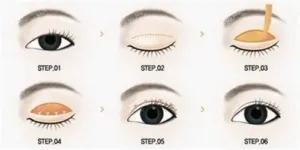
In conclusion, there is no universal “best” double eyelid surgery. The buried suture method focuses on non-invasion and fast recovery for those with perfect primary eye conditions. The three-point minimally invasive method balances effect and recovery for mild imperfect eye conditions. The full-incision method provides thorough and permanent improvement for complex and aging eye conditions. In formal medical aesthetics, professional doctors will evaluate individual eye structure, skin condition, age, and aesthetic preferences to customize the most suitable surgical plan, ensuring both beauty and safety.