False eyelashes have evolved from a niche beauty accessory to a global makeup staple, enhancing eye beauty and shaping diverse makeup looks for people around the world. As the demand for false eyelashes continues to soar, a question often arises: are there false eyelash factories in developed countries such as the United States and the United Kingdom? To answer this question, we first need to trace the development history of false eyelashes, understand the global distribution of false eyelash factories, and then explore the deep-seated reasons why developed countries rarely have such factories.
The history of false eyelashes dates back much earlier than many people think. As early as 2000 BC, there were records of false eyelashes in ancient Egyptian and Roman documents, where people used materials like feathers and animal hair to decorate their eyelashes, symbolizing status and beauty. However, modern false eyelashes as we know them today originated in the early 20th century. In 1916, a Hollywood makeup artist created the first pair of modern false eyelashes using human hair to meet the needs of film shooting, making the eyes of actors more vivid on the screen. Since then, false eyelashes gradually entered the public’s vision, and after the 1950s, with the rise of the beauty industry, they became popular among ordinary consumers. In the late 20th century, the invention of synthetic fibers (such as PBT) replaced traditional natural materials, making false eyelashes more affordable, durable and diverse, laying the foundation for the large-scale production of false eyelashes.
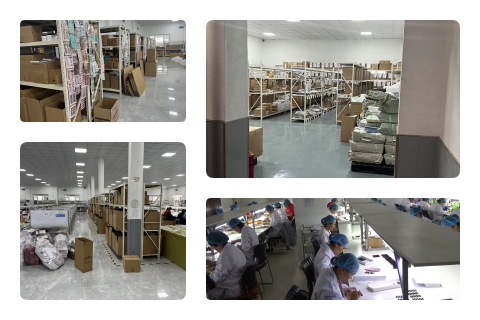
Today, the global false eyelash industry has formed a clear production and distribution pattern, with factories mainly concentrated in developing countries, while developed countries are almost absent of large-scale false eyelash production factories. The most prominent production base is China, especially Pingdu City in Shandong Province, known as the “Lash Capital of China”. Pingdu produces 80% of China’s false eyelashes and accounts for 70% of the global market share, with nearly 5,000 market entities and more than 20,000 processing points, solving the employment problem for hundreds of thousands of people. Every year, about 20 billion pairs of false eyelashes are exported from Pingdu to all parts of the world. In addition to China, other developing countries such as Indonesia and Vietnam also have a small number of false eyelash factories, mainly focusing on mid-to-high-end products or OEM production for international brands.

In contrast, developed countries such as the United States and the United Kingdom have almost no large-scale false eyelash production factories. Although there are a few small-scale workshops or custom-made studios, they are not engaged in mass production, and most of their products are high-end custom-made products with extremely high prices, which cannot meet the mass market demand. Most of the false eyelashes sold in developed countries are imported from China, South Korea and other developing countries, and local brands mainly focus on product design, brand operation and sales, rather than production.
There are three core reasons why developed countries do not have large-scale false eyelash factories, which are closely related to the characteristics of the false eyelash industry and the industrial positioning of developed countries.
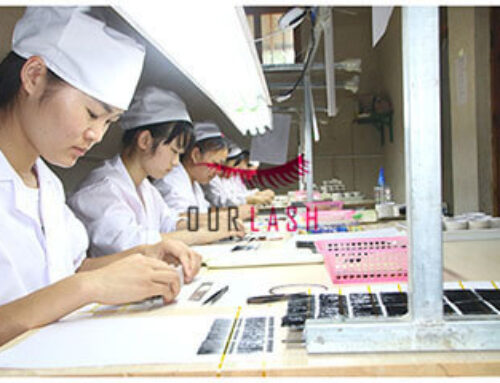
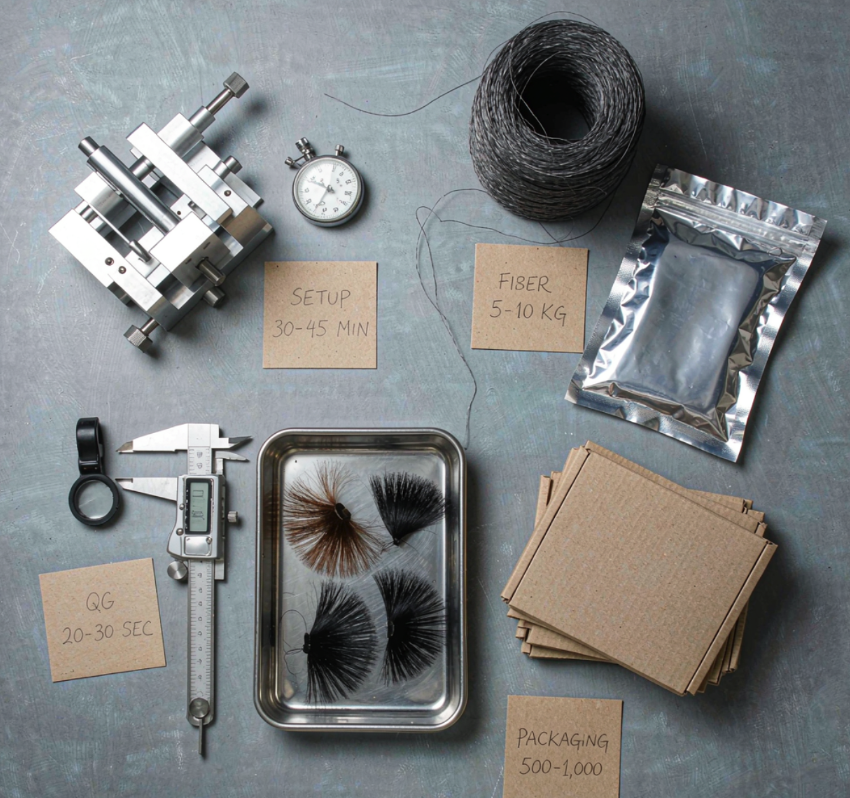
First, false eyelash production is a labor-intensive industry, which is not compatible with the high labor cost in developed countries. The production of false eyelashes involves 17 processes including hair pressing, cutting, curling, shaping, and packaging, many of which require manual operation, such as sorting lash fibers and pasting lash bands. In developed countries such as the US and the UK, the minimum wage is high, and the labor cost per worker is several times that of developing countries. If false eyelashes are produced locally, the production cost will be significantly increased, making the products lose market competitiveness. In contrast, developing countries have abundant and low-cost labor resources, which can effectively reduce production costs and meet the demand for mass production of low-to-medium-priced false eyelashes.
Second, developed countries lack a complete industrial chain supporting false eyelash production. The production of false eyelashes requires upstream raw materials such as synthetic fibers (PBT), glues, and packaging materials, as well as downstream processing, testing, and logistics support. Developing countries such as China have formed a complete industrial chain after decades of development—for example, Pingdu has gathered raw material suppliers, production factories, testing institutions, and logistics companies, forming a mature industrial ecosystem that can reduce procurement and logistics costs. However, in developed countries, the related supporting industries are relatively scarce, and enterprises need to import raw materials from other countries, which further increases production costs and reduces production efficiency.
Third, strict environmental regulations in developed countries also limit the establishment of false eyelash factories. The production process of false eyelashes, especially the production of glues and synthetic fibers, may produce certain pollutants. Developed countries have extremely strict environmental standards, and enterprises need to invest a lot of money in environmental protection equipment and pollution treatment to meet the standards, which further increases the investment cost of building factories. For example, the UK has added restrictions on microplastic components in beauty tools, requiring false eyelash manufacturers to submit safety demonstration reports if they use microplastic-containing materials, which increases the production and compliance costs of enterprises. In contrast, developing countries have relatively loose environmental regulations in the early stage of industrial development, which reduces the environmental protection investment of false eyelash factories.
In addition, the industrial positioning of developed countries also determines that they will not focus on false eyelash production. Developed countries tend to focus on high-value-added industries such as brand operation, product design, and technological research and development, while transferring labor-intensive and low-value-added production links to developing countries. For example, many well-known false eyelash brands in the US and the UK do not have their own production factories, but entrust production to factories in China and other countries, and focus on product design, marketing and after-sales service to obtain higher profits.
In conclusion, there are almost no large-scale false eyelash factories in developed countries such as the US and the UK. This phenomenon is not accidental, but the result of the combined effect of labor costs, industrial chain supporting facilities, environmental regulations and industrial positioning. The global false eyelash production pattern, with developing countries as the main production bases and developed countries as the main consumption and brand operation markets, is in line with the law of global industrial division of labor. With the continuous development of the false eyelash industry, developing countries are also constantly upgrading their industrial level, from OEM production to independent brand building, while developed countries will continue to maintain their advantages in brand and design, forming a complementary global industrial pattern.
This is OURLASH, if you have other questions about eyelash, contact with us.