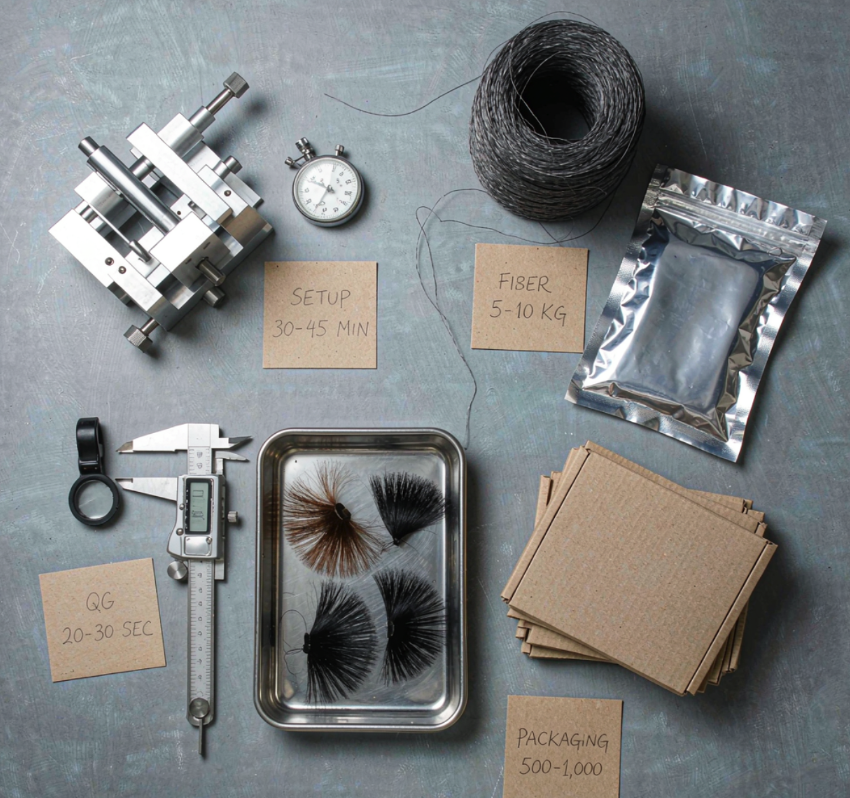
Short answer: a tray-and-sleeve box runs $0.28–0.45 per unit at 5,000 pieces, CMYK print adds $0.05–0.08, foil and soft-touch push past $0.60, and the print run itself has a 500–1,000 piece minimum that stacks on top of your lash MOQ. Packaging is where most private label budgets quietly break — not because boxes are expensive, but because brands spec them like consumer products instead of like production runs.
This is the packaging layer of private label: the box formats, what each print process actually costs per unit, how the packaging minimum layers onto the lash minimum, and the humidity problem that ruins pre-glued lines the first summer. The full private label guide covers the whole program; this article goes deep on the box.
Five Box Formats and What Each One Says
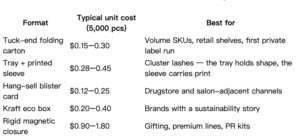
One decision in that table matters more than the rest: rigid boxes signal premium, but they multiply shipping cost. A rigid box is not flat-packable — it ships assembled, so freight volume triples and the per-unit landed cost ends up $0.40–0.60 above the box price. Most first-time brands over-buy here. A tuck carton with soft-touch lamination reads premium at a third of the landed cost, which is why the wholesale price guide shows established brands defaulting to folding formats.
Print and Finish: Four Tiers, Priced Per Unit
Single-color offset. One Pantone on white or kraft board. $0.02–0.04 per unit at volume. Enough for a wordmark and a barcode — plenty for brands whose identity lives on the lash tray, not the box.
Full CMYK process. Four-color print, photographs and gradients possible. Adds $0.05–0.08 per unit. This is the default for most private label runs and where 80% of brands stop.
Soft-touch lamination + spot UV. The matte-rubber feel with one glossy element — usually the logo. Lamination adds $0.08–0.12, spot UV another $0.04–0.06. This combination is what makes a $0.30 box read like a $1.20 box on shelf.
Foil stamping and embossing. Metal dies, one-time tooling of $80–200 per design, then $0.10–0.15 per unit per stamped area. Worth it for holiday or gifting SKUs; overkill for a volume line. Ask for the die cost to be waived at 10,000+ pieces — most printers fold it in.
A packaging quote that looks cheap usually leaves the print tier vague. “Custom box $0.25” means nothing until you know whether that’s one color or four, laminated or bare. The cost breakdown guide applies the same logic to the lash side of the quote.
The Double Minimum: Where Budgets Actually Break
Packaging has its own MOQ, and it stacks on top of the lash MOQ. The math most brands miss: lash MOQ 1,000 pairs, box print run 1,000 pieces — fine. But lash MOQ 1,000 with box minimum 2,000 means you either order 2,000 pairs or store 1,000 empty boxes until the reorder. Both are cash sitting still.
Three ways around it. Ask for a digital-print run at 300–500 pieces — higher per-unit cost ($0.08–0.15 more), no plate cost, and most printers in Qingdao now run digital below 1,000. Ask whether the printer stocks your board size — stocked dies cut the minimum in half. Or start with a two-SKU box design where a printed belly band differentiates the SKUs, so one print run serves two products. The MOQ guide covers the same stacking problem from the lash side.
Humidity: The Part Brands Learn in August
Lash packaging has a job most product packaging doesn’t: climate control. PBT fiber holds shape, but the bond doesn’t. Pre-glued clusters in a standard paper box will begin losing tack within weeks in a humid warehouse, because paper breathes.
Pre-glued SKUs need sealed sachets — foil or metallized film, heat-sealed with a desiccant pack inside, targeting 40–50% internal humidity. That sachet adds $0.06–0.10 per unit and its own machine run. This is one of the real cost gaps between pre-glued and bond-and-seal formats, which the format comparison covers from the buyer side. Bond-and-seal clusters are more forgiving, but the bond tube still shouldn’t ship in unlined kraft if your market includes tropical climates — kraft wicks moisture straight into the cap seam.
The customer-side version of the same problem shows up in reviews: lashes stored in a humid bathroom lose bond life. Your box insert is the place to say so, and the storage guide covers what that messaging should tell buyers to do.
Size Fit: Cluster, Strip, Extension — Three Different Boxes
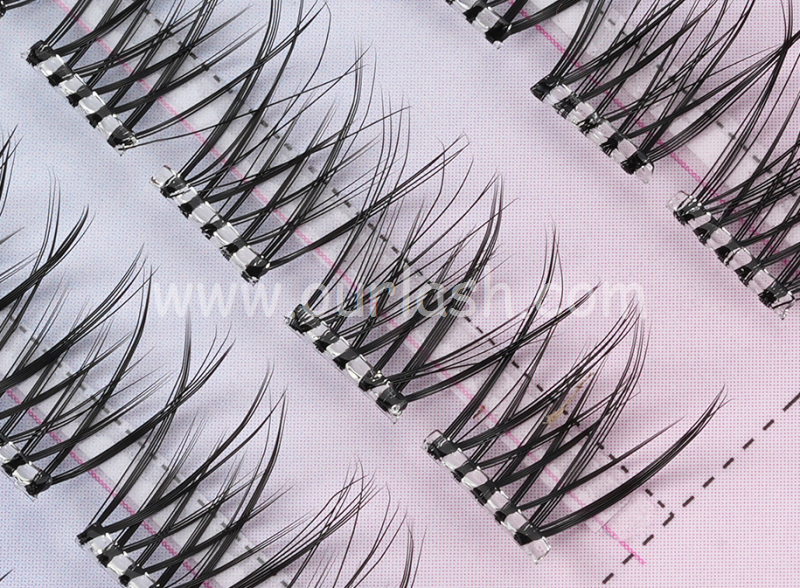
Cluster lashes ship best in a tray-and-sleeve because the clusters need a formed tray to keep fibers from crushing. Strip lashes work in a slim tuck carton — the strip is its own spine. Extension trays need depth; a flat box crushes the curl before the box is even opened. Spec the box after the product, never before. When brands pick a box format because a competitor’s looked good, the product is usually reformatted to fit the packaging, and reformatted products wear differently. The format comparison explains the wear-side differences.
Kits are their own discipline. A bond tube, tweezers, clusters, and a seal in one box means molded inserts, and molded inserts mean tooling — $150–400 for a vacuum-formed tray insert, reusable across runs. The DIY kit guide covers how those components are usually bundled.
Timeline: Packaging Adds Days, Not Weeks
Box print adds 5–7 days to an order when the design is final. Add 3–5 more if foil tooling is involved, and a first-article round of 2–3 days if you want to see and approve a physical printed proof — you should. The proof round is where Pantone drift, text errors, and wrong board weight get caught. Approving print from a PDF is how brands end up with 2,000 boxes printing “silk lashe”.
Total realistic private label packaging timeline from approved artwork: 10–14 days including proof, print, die-cut, and assembly at the lash factory. If a vendor quotes private label delivery in under two weeks with custom packaging included, ask directly whether the box is being printed or pulled from their generic stock — the vendor selection guide has the full question list for moments like this.
Six Things That Go Wrong, Ranked by Cost
- No Pantone spec.“Nude” printed on two different runs comes out two different colors. Every color on the box gets a Pantone number, written into the purchase order.
- Barcodes that don’t scan.GS1-issued numbers only, printed at minimum 80% scale on a flat surface, never over a fold. Printers will happily print an unregistered barcode you’ll have to sticker over later.
- Missing regulatory text.Ingredient lists for the bond, country of origin, and net weight placement rules vary by market. Your market’s requirements belong in the artwork brief, not discovered at customs.
- Glue dot placement on the tray.A glue dot holding the lash tray in place that’s too strong tears the tray on opening. Specify peel strength, and check it on the proof sample, not after 5,000 are assembled.
- No drop test.A packed carton should survive a 1.2-meter drop on the corner. Rigid boxes with no interior support fail this. Any fulfillment center will reproduce the test for free within a week of arrival.
- Freight math on rigid boxes.Covered above, worth repeating: rigid packaging triples shipping volume. If the landed cost matters more than the unboxing video, fold instead.
Artwork Handoff: What the Printer Actually Needs
The print-ready file is not the design file. A printer in Qingdao expects: CMYK or Pantone-assigned artwork, 3 mm bleed on all sides, dieline as a separate non-printing layer, fonts outlined, barcode at final size with the quiet zone intact, and a mockup image showing which panel is the front. Files delivered as RGB screenshots get rebuilt by the printer’s layout person, and every rebuild is a chance to introduce the error you approved a proof to catch. Send the five-line spec from the factory view section along with the file — board weight, Pantone numbers, finish, peel strength, humidity target — and the quote you get back will be the quote you actually pay.
FAQ
Q: What is the minimum order for custom lash boxes?
500–1,000 pieces for offset print, 300–500 for digital print at a higher unit cost. The box minimum stacks on top of the lash MOQ, so confirm both before committing.
Q: Can I get boxes printed if my lash order is small?
Yes — digital print at 300–500 pieces costs $0.08–0.15 more per unit but skips plate fees. It’s the standard route for a first private label run or a market test.
Q: How much does custom lash packaging cost per unit?
A folding carton with CMYK print lands around $0.20–0.38 per unit at 5,000 pieces. Foil, soft-touch, or rigid formats push the range to $0.60–1.80.
Q: Do I need sealed sachets for pre-glued lashes?
Yes. Pre-glued clusters need moisture-barrier sachets with desiccant, sealed at 40–50% internal humidity, or the adhesive loses tack in storage.
Q: Whose responsibility is the barcode and regulatory text?
Yours. The factory prints what you supply. Register barcodes through GS1 yourself and confirm your market’s labeling rules before artwork is finalized.
The Factory View: Spec the Box Like a Production Part
Packaging is a production component, not a marketing decision that happens at the end. The brands that run clean private label programs treat the box spec the way they treat the lash spec: board weight in grams, Pantone numbers in writing, peel strength on the tray glue, humidity target for sealed sachets, drop test in the QC checklist. Everything else — the unboxing feel, the shelf presence — follows from getting those five lines right.
Where this fails is when packaging is chosen before the product is final. We’ve reprinted boxes three times for one client because the cluster count changed after the box was approved. Sequence it: product spec, then box spec, then artwork, then print. The startup guide sequences the same decisions for a first launch, and the wholesale guide frames packaging as one line in the larger order.
Want packaging quoted against a specific format and quantity? Send us your box concept and target volume and we’ll quote the print tiers and landed cost. Or start from the cluster line and spec packaging around it.